Espresso Channeling: What It Is, What It Looks Like, How to Fix It
What channeling actually is
An espresso puck should be a uniform bed of coffee that water permeates evenly. But grounds clump, mound, and settle unevenly. Wherever the puck is slightly less dense, pressurized water forces its way through, widening that weak spot into a channel. Once a channel opens, most of the water takes it — the surrounding coffee barely gets touched.
Result: part of your coffee over-extracts (bitter, harsh) and part under-extracts (sour, thin). You get the worst of both worlds in one cup.
How to spot channeling (4 signs)
1. Spritzers and spurting
Watch a naked (bottomless) portafilter during extraction. A good shot shows honey-like streams merging into one central flow. Channeling shows as thin jets squirting sideways. If you’ve ever been sprayed by your portafilter, that’s channeling.
2. Blonding in patches
With channeling, you’ll see pale streaks or spots early while the rest still runs dark. Uneven color = uneven extraction.
3. Donut extraction
On a bottomless portafilter, the first drips should appear across the whole basket surface roughly simultaneously. If drips start in one area and spread outward, water is favoring part of the puck.
4. The taste: sour AND bitter at once
This is the giveaway without a bottomless portafilter. A shot that’s simultaneously sharp/sour and harsh/dry is almost certainly channeled. Pure sour = grind finer. Pure bitter = grind coarser. Both at once = fix your puck prep.
Why channeling happens (ranked by likelihood)
- Clumpy grounds. Static makes grounds clump; dense clumps resist water while loose areas around them become channels.
- Uneven distribution. Dosing leaves a mound or slope; water attacks the thin spots.
- Bad tamp. A tilted tamp compresses one side more; the loose side channels.
- Too-fine grind + too-high dose. An over-compressed puck cracks under pressure, and cracks are superhighways for water.
- Worn or low-quality basket. Cheap stock baskets have inconsistent hole patterns.
How to fix it (in order of impact)
Fix 1: Get a WDT tool (~$15, biggest upgrade per dollar in espresso)
WDT (Weiss Distribution Technique) means stirring the grounds with fine needles to break up clumps and homogenize the bed. Ten seconds, works better than any other single technique change.
Do this: After dosing, stir thoroughly with a WDT tool — needles 0.3–0.4mm, several passes, all the way to the bottom. The bed should look like smooth, even sand.
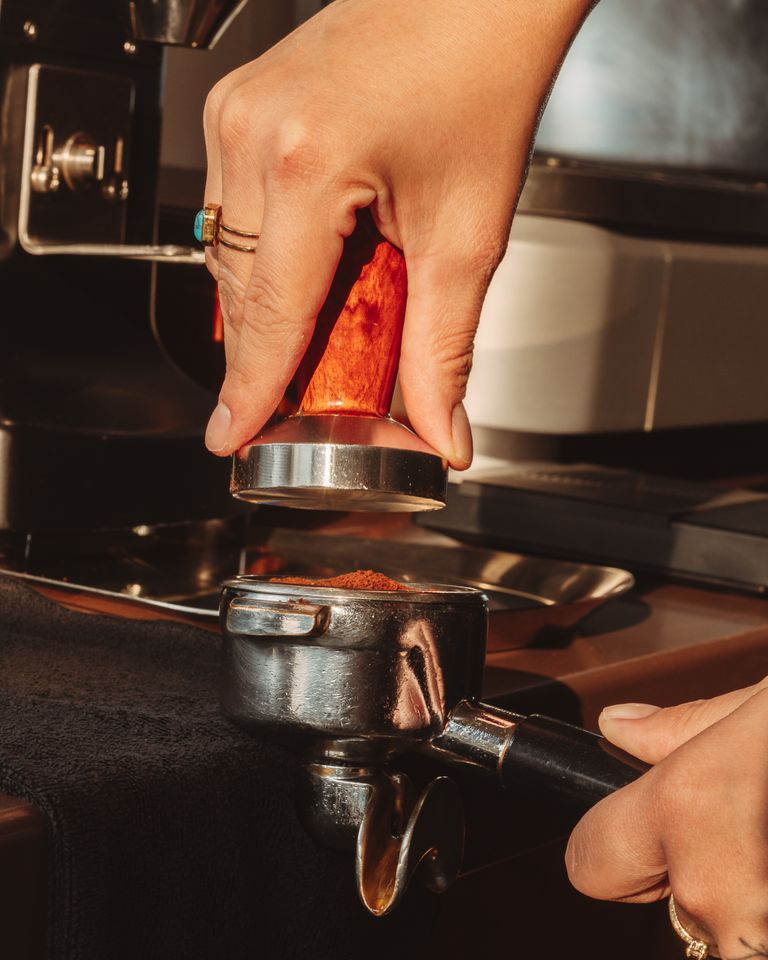
Fix 2: Tamp level, not hard
Forget “30 pounds of pressure” — levelness matters far more than force. A 15-lb level tamp beats a 30-lb tilted tamp every time.
Fix 3: Dose correctly for your basket
Under-dosing leaves headspace where water jets disturb the puck; over-dosing cracks it against the shower screen. Use the basket’s rated dose (18g for a standard double).
Fix 4: Grind fine enough — but not too fine
Grinding too fine for your machine can fracture the puck, which channels worse than a slightly coarse grind. If you’ve gone finer chasing sweetness and the shot got more chaotic, back off a step.
Fix 5: Upgrade the basket (~$25–35)
A precision basket (VST, IMS, or Pullman) has uniform holes versus the irregular holes of stock baskets. One of the best sub-$40 upgrades for any machine.
Fix 6: Consider a puck screen (~$10)
A thin metal mesh on top of the tamped puck disperses the incoming water jet and keeps the puck surface intact. Cheap, no downside.
The anti-channeling routine (30 seconds, every shot)
- Dose 18g into the basket
- WDT thoroughly — break every clump
- Settle and level the bed
- Tamp straight and level
- Optional: place puck screen on top
- Lock in and pull immediately
Can you fix channeling after the shot starts?
No — once water has carved channels, that shot is done. Channeling is prevented in prep, not corrected mid-extraction.
Do I need a bottomless portafilter to diagnose channeling?
It helps enormously, but the taste test (sour + bitter simultaneously) works without one. A bottomless portafilter (~$30–40) is the best diagnostic tool a beginner can buy.
Does a distribution tool replace WDT?
No — WDT breaks up clumps through the bed; a spinning distributor only levels the surface. WDT first, distributor after if you like. If you buy one, buy the WDT tool.
My grinder clumps badly — is WDT enough?
WDT handles moderate clumping. But if your grinder produces boulders-and-dust, WDT can’t fix particle inconsistency — at that point the grinder itself is the ceiling.